


Instagram boss Adam Mosseri rejects claims is 'addictive'
Instagram’s boss says its algorithm is only guessing what users value, while rejecting claims that the platform is addictive.

According to Instagram boss Adam Mosseri, I have one of the most “positive algorithms” he’s come across “in a long time.”
Well then, looks like I can cut back my therapy sessions to once a fortnight.
Or, maybe not.
During an Australian media roundtable, Mosseri also admitted Instagram does not really know what users want to see. Instead, it watches what they do, assigns value to those actions and makes an expensive guess.
“What we want to do is help you not miss things that you want to see, that you would say are worth your time, but we don't know what you want to see,” he said.
So much for Instagram knowing us better than we know ourselves.


The leading media trade publication in Australia.
Get our top stories straight to your inbox daily by signing up to our Newsletter
By providing your information, you agree to our Terms of Use and our Privacy Policy. We use vendors that may also process your information to help provide our services.
Instagram is making an educated guess
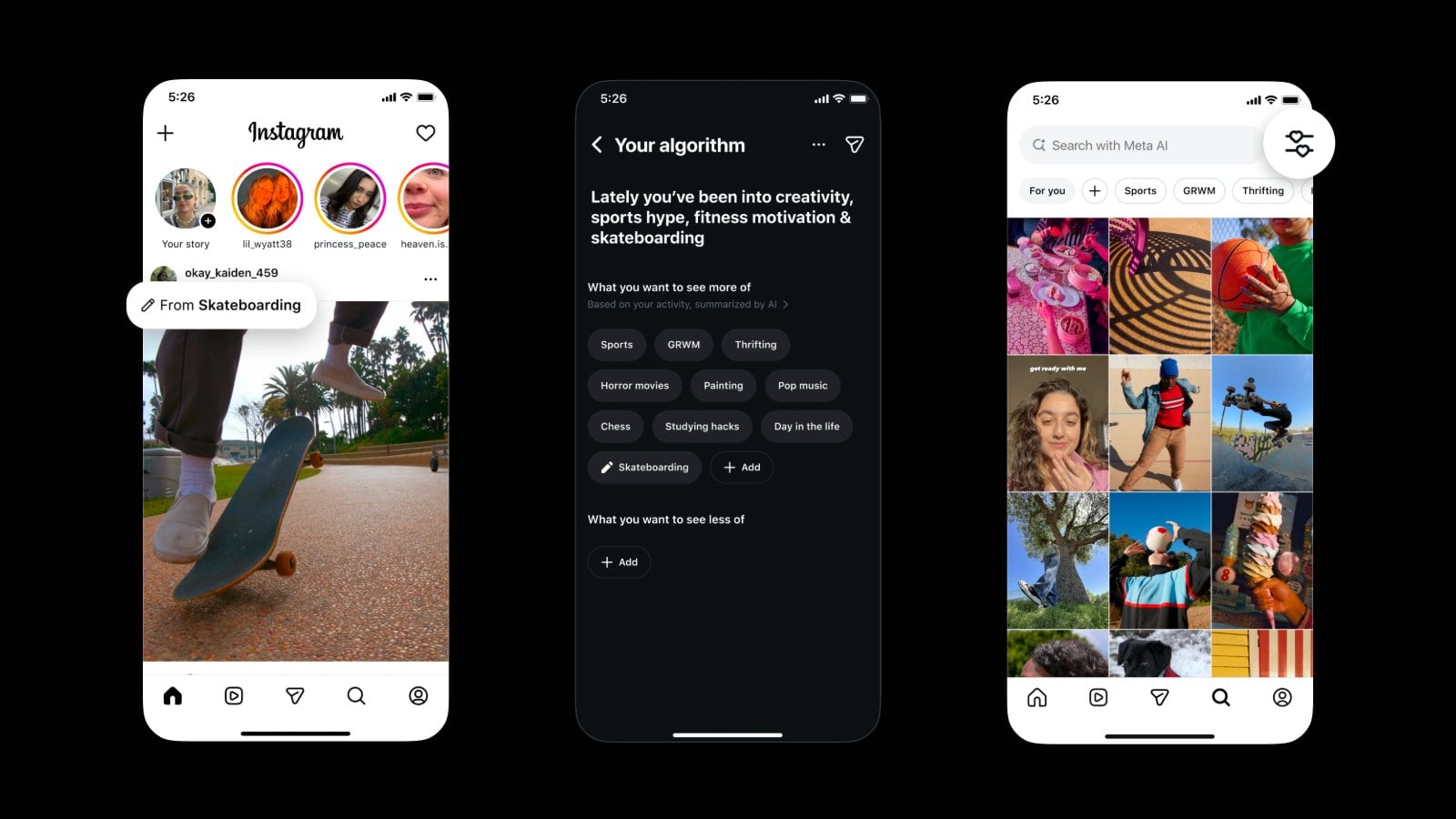
The roundtable where Mosseri made the comments was held to announce Instagram's new AI-powered feature, Your Algorithm, which lets users view and adjust the topics shaping their Reels recommendations.
Users can add topics they want to see more of or remove interests they no longer find relevant. Users access the feature through an icon with two hearts and sliders in the top-right corner of Reels.
It offers a little more control. But Mosseri’s explanation of how Instagram decides what to serve makes clear the platform still relies heavily on observable behaviour, and not necessarily what users consciously say they want.
“We use what you interact with as a proxy for how interested you are in something, and so if you tend to like and comment on funny videos of cats, we will infer that you might be interested in similar videos, which are probably of cats, and then be more likely to show you one from an account you follow, or even an account you don't follow,” Mosseri said.
According to Mosseri, Instagram studies what users like, share, comment on and watch to completion. It also monitors whether they visit an account’s profile.
“Then we basically add values to each of those outcomes, and then we compile them into a score, which is a relevancy score, and so we order things by how interested we think you are in them, but it's just a guess. It's an educated guess; it's an expensive guess, but it's a guess, and we try to get better over time,” he said.
But see, here's where things get a little blurry.
Watching a video is not the same as wanting it. Pausing at something disturbing does not necessarily signal enjoyment. Sending a meme to a friend can mean disbelief rather than approval.
Yet those measurable actions remain the raw material Instagram uses to construct a version of you.
What users want is not necessarily the point
Mosseri said Instagram does not believe its job is to present content users agree or disagree with.
“We think it's our job to show you stuff you're interested in and would say is worth your time.”
The trouble is that “worth your time” is slippery. Instagram cannot see regret, boredom or the mild psychic exhaustion that arrives after spending 40 minutes watching strangers reorganise their fridges.
Mosseri acknowledged that the platform’s systems can favour behaviour that is easy to quantify.
“It's not. We make mistakes. One thing that frustrates me about ranking is that we end up over-optimising for things we can measure and undervaluing things that are harder to measure.”
He added: “I do want to acknowledge that the system isn't perfect and I don't want to pretend otherwise.”
The new controls are designed to return some agency to users after social platforms shifted from feeds dominated by followed accounts to recommendation engines filled with unfamiliar creators, brands and publishers.
“Everyone's gone that way because it drives engagement, and it drives preference actually over the long run, and it drives sentiment, and it drives pretty much all the things that most companies care about, but it doesn't drive a sense of agency,” Mosseri said.
Instagram plans to expand the controls beyond Reels into Explore and other areas of the app. Mosseri said users should eventually receive more specific explanations for recommendations and be able to modify them in real time.
Mosseri rejects the addiction label
Mosseri was more definitive when asked whether Instagram is addictive.
“I don't believe Instagram is addictive. I know that is controversial to say.”
His argument rests on the difference between the casual use of the word and a recognised clinical addiction.
“So none of the science I have seen suggests that social media, or any media for that matter, is actually clinically addictive,” he said.
He's not wrong.
Social media addiction is not currently recognised as a standalone diagnosis in the American Psychiatric Association’s DSM-5-TR.
But that does not settle the broader debate over compulsive use, harmful design or Instagram’s effects on mental health.
In 2023, dozens of US states sued Meta, alleging it had deliberately designed features on Instagram and Facebook to keep young users compulsively engaged. Meta disputed the claims and pointed to the safety tools it had introduced.
The European Commission also opened proceedings in 2024 examining whether Facebook and Instagram’s interfaces could stimulate behavioural addictions in children, including through so-called rabbit-hole effects. Those proceedings concern platform design and risk management, rather than whether Instagram meets the threshold for a recognised clinical diagnosis.
Mosseri may be technically right that Instagram addiction is not an established psychiatric condition. That is not quite the same as proving the platform cannot encourage compulsive behaviour.
And it is a curious defence from the person running an app built around an infinite supply of personalised content.

More control, within limits
Your Algorithm represents a practical admission that Instagram’s predictions can be wrong and that users want greater influence over what enters their feeds.
Mosseri said the long-term goal was to make Instagram’s decision-making more transparent.
“You should be able to actually ask, why am I seeing this and get a really specific answer, and then ask for modifications and have the algorithm respect that in real time”
For now, Instagram is offering users a clearer look inside the machine. What they find is not an algorithm that knows them intimately, but one that makes predictions from clicks, pauses, shares, and late-night scrolling.
It is watching what we do. Whether that amounts to understanding what we want is another question entirely.
More from Mediaweek
The leading media trade publication in Australia.
Get our top stories straight to your inbox daily by signing up to our Newsletter
By providing your information, you agree to our Terms of Use and our Privacy Policy. We use vendors that may also process your information to help provide our services.


