


Nine profit rises as Stan and QMS offset TV weakness
Stan, QMS and subscriptions lifted earnings as Nine reshaped its assets and cut exposure to its legacy media operations.

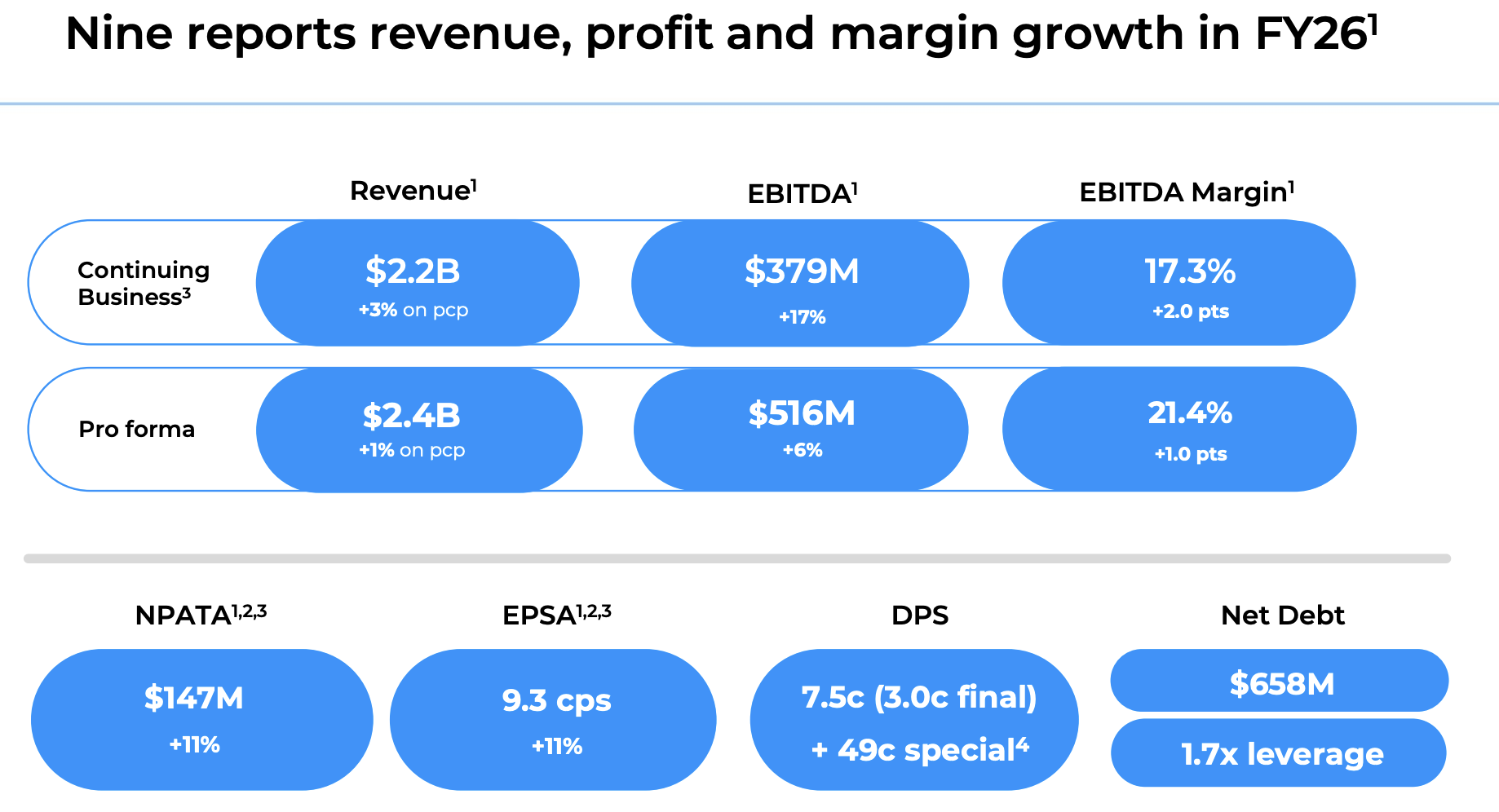
Nine Entertainment Co has lifted full-year EBITDA 17% to $379 million, with growth from Stan, QMS and the company's mastheads helping offset continued weakness in the television advertising market.
Revenue from continuing operations rose 3% to $2.19 billion for the 12 months to 30 June 2026, while net profit after tax before specific items and acquisition-related amortisation rose 11% to $147 million.
On a pro forma basis, which includes a full year of QMS Media in both FY25 and FY26, revenue rose 1% to $2.4 billion, and EBITDA increased 6% to $516 million.
Statutory net profit was $511 million, boosted by an $849 million discontinued-operations result, predominantly from the sale of Nine's stake in Domain. That was partly offset by $481 million in after-tax specific items, including a $404 million impairment of Total Television.
Nine chief executive officer Matt Stanton said the result followed a year in which the company significantly reshaped its portfolio.
"Over the past 12 months, we have made material changes to our business portfolio, focusing on growth and digital assets whilst reducing our exposure to structurally challenged and smaller assets," Stanton said.
"These transactions add to our operational scale and create a higher growth and more resilient Nine, better positioned to create long-term sustainable value for our shareholders."


The leading media trade publication in Australia.
Get our top stories straight to your inbox daily by signing up to our Newsletter
By providing your information, you agree to our Terms of Use and our Privacy Policy. We use vendors that may also process your information to help provide our services.
READ MORE: Clemenger BBDO wins Stan creative account
Nine reshapes its portfolio
Nine completed its acquisition of QMS Media on 31 March, while selling Nine Radio, Pedestrian Group and its stake in Future Women.
Nine also sold its NBN and Darwin regional television businesses and moved them to affiliate arrangements with WIN, while it completed the sale of its stake in Domain during the financial year.
Nine expects its growth businesses, comprising Stan, 9Now, Outdoor and Digital Publishing, to contribute more than 60% of group revenue and about 70% of EBITDA in FY27.
Stan delivers record profit
Stan recorded its fourth consecutive year of profit growth, with EBITDA climbing 34% to a record $81 million.
Revenue rose 16% to $569 million, driven largely by Stan Sport, where average subscriber numbers increased almost 50% year-on-year following the addition of Premier League rights from August 2025.
Stan now has about 2.3 million paying subscribers, while average revenue per user increased 8% over the year.
On the entertainment side, Married At First Sight spin-off After the Dinner Party was Stan's biggest subscriber driver of the year. Other performers included Love Island (USA), From, Power Book IV: Force and Sullivan's Crossing.

Total TV takes the hit
The picture was weaker across Total Television, which combines Broadcast TV and 9Now.
Revenue fell 9% to $1.03 billion, while EBITDA dropped 12% to $134 million as the television advertising market remained soft and Nine cycled the Paris Olympics and federal election broadcasts from the previous year.
Nine estimated underlying Total TV revenue, excluding both the Summer and Winter Olympics, fell about 2%.
The company also rebased the carrying value of Total TV to reflect current free-to-air advertising market conditions, recording a $404 million after-tax impairment as a specific item.
The writedown was mainly applied against broadcast licences, property, plant and equipment, software and legacy international content rights. Nine said no impairment or onerous contract provisions were applied to its sports rights or local programming.
Total TV's carrying value now sits at about $360 million.
QMS adds to the numbers
QMS contributed $55 million in EBITDA during its first three months under Nine ownership.
On a pro forma full-year basis, QMS revenue rose 15% to $295 million, and EBITDA increased 18% to $192 million.
Australian revenue increased 10%, ahead of reported outdoor market growth of 6%, while QMS' New Zealand revenue rose 48% in local currency terms.
Nine Publishing reported broadly flat revenue of $518 million and EBITDA of $150 million, down 3%.
The mastheads, including The Sydney Morning Herald, The Age, The Australian Financial Review, Brisbane Times and WA Today, grew revenue 3% to $460 million and EBITDA 4% to $153 million.
Digital subscription revenue increased 15%, marking the mastheads' third consecutive year of double-digit subscription revenue growth. Nine now has about 510,000 masthead subscribers and more than 2.2 million registered users.
Cost cuts ahead of target
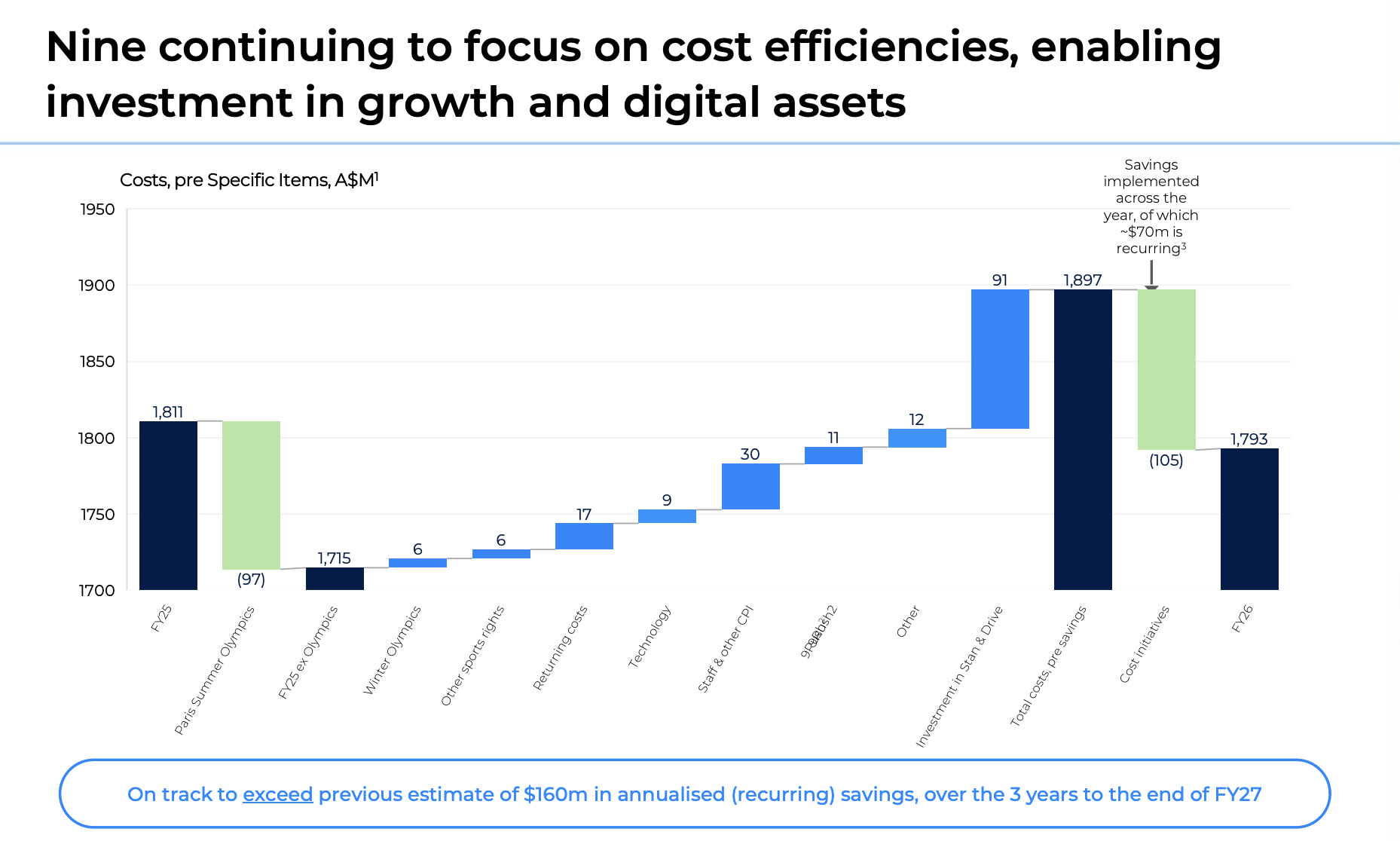
Nine delivered about $105 million in cost savings during FY26, with around $70 million expected to be ongoing.
The company now expects to exceed its previous target of $160 million in annualised recurring savings by the end of FY27.
"We expect to exceed our three-year cost-out target of $160m to June FY27," Stanton said.
"We will continue to refocus our cost base, removing costs where appropriate whilst continuing to invest in our growth businesses."
Dividend and debt
Nine declared an unfranked final dividend of 3 cents per share, payable on 22 October 2026.
That takes the full-year dividend to 7.5 cents per share, unchanged from FY25, representing a payout ratio of about 80% of EPSA.
Net debt stood at $658 million at 30 June, compared with $451 million a year earlier. Net leverage was 1.7 times, slightly better than Nine's previous guidance.
Nine said the increase reflected the QMS acquisition and other transactions completed during the year, with leverage expected to remain broadly around current levels through FY27.
FY27 outlook
Nine expects another year of pro forma revenue and EBITDA growth in FY27, led by Stan, Digital Publishing and QMS.
Stan is expected to benefit from its second season of Premier League rights and the introduction of its advertising-supported entertainment tier from 1 August.
The near-term outlook for Total TV remains tougher.
Nine expects first-quarter Total TV revenue to fall between 7% and 8% compared with the same period last year, citing a later start for The Block and the impact of the FIFA World Cup and Commonwealth Games airing on rival networks.
Stanton also pointed to the Australian Parliament's passage of the News Bargaining Incentive as "a significant milestone," as well as Nine's recently secured long-term NRL rights agreement.
"I am excited about what the future has to offer," Stanton said.
"Having completed a number of transactions in FY26, we are now focused on operational execution, maximising the potential and returns of our business, and delivering future growth."
Nine will provide its next trading update at its annual general meeting in October.
More from Mediaweek
The leading media trade publication in Australia.
Get our top stories straight to your inbox daily by signing up to our Newsletter
By providing your information, you agree to our Terms of Use and our Privacy Policy. We use vendors that may also process your information to help provide our services.


.jpg%3Fv%3D1787182076622&w=3840&q=75)